Decision Deadlock: Why You’re Stuck — And the Shift That Unlocks Movement
The Illusion
“If we don’t agree on the way forward, we can’t move forward.”
This illusion shows up as:
• Endless discussions
• Circular arguments
• Subtle power struggles
• Emotional fatigue masked as ‘being thorough’
• Decisions that get postponed “until things are clearer”
Underneath it sits a quiet assumption:
There is one right path — and unless we agree on it, we’re stuck.
That assumption closes the system.
What’s Really Happening
Most couples and families in business aren’t fighting about the goal.
They’re fighting about the route.
One wants speed.
The other wants safety.
One wants certainty.
The other wants flexibility.
Each path feels right — because it protects something that matters.
The mistake is trying to resolve this at the path level.
How to think of this …
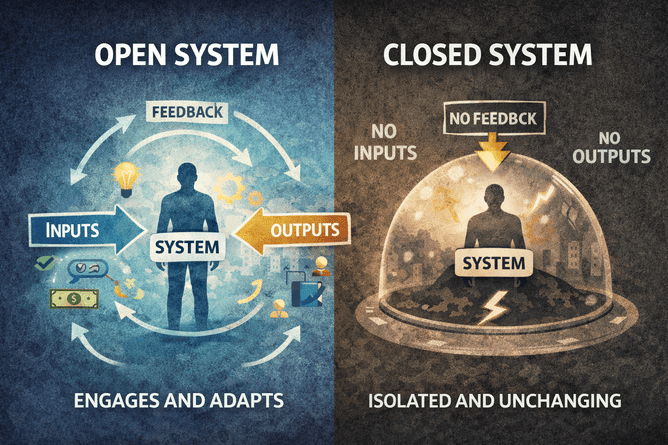
Everything operates within a system – nervous system, health system, operating system, transport system, solar system … nothing exists in isolation.
There are open systems and closed systems.
Open systems are systems that continuously interact with their environment — they take things in, transform them, and send things back out.
They are not closed or self-contained. They survive, adapt, and improve because of those interactions.
The simplest way to think about it
An open system has:
1. Inputs – resources, information, energy, people, money
2. Transformation – work, thinking, processes, decisions
3. Outputs – products, services, outcomes, behaviours
4. Feedback loops – signals from the environment that tell the system how it’s doing
5. Adaptation – changes made based on that feedback
Examples of open systems (everyday & business)
🌱 A living organism
• Inputs: food, oxygen
• Outputs: energy, waste
• Feedback: pain, hunger, fatigue
• Adaptation: rest, eat, heal
🏢 A business
• Inputs: customers, capital, staff, ideas
• Outputs: products, services, profit, impact
• Feedback: sales, complaints, market shifts
• Adaptation: strategy changes, new roles, new offers
👨👩👧👦 A couple or family in business
• Inputs: expectations, stress, money, emotions, goals
• Outputs: decisions, behaviours, results
• Feedback: tension, alignment, ease, conflict
• Adaptation: conversations, role clarity, boundaries
When couples or families stop listening to feedback, they act like closed systems - and that’s when problems compound.
Open vs Closed systems (key difference)
Closed system | Open system |
|---|---|
Resists change | Learns from change |
Defends status quo | Evolves continuously |
Ignores feedback | Seeks feedback |
Optimises internally | Optimises in context |
Breaks under pressure | Adapts under pressure |
No real human or business system is truly closed - but many behave as if they are.
The Insight (Open Systems Thinking)
In open systems:
• Equifinality means there are many valid paths to the same outcome
Examples:
o Business:
Two companies reach profitability - one through premium pricing, another through volume.
o Couples in business:
One couple gets aligned via deep weekly conversations; another through clearer roles and decision rules.
o Health:
VO₂ max improves via interval running or cycling or rowing.
• Multifinality means the same starting point can lead to very different futures
Examples:
o Business:
Two companies start with the same product and market, yet one builds sustainable profit while the other collapses under pressure because of very different leadership and decision choices.
o Couples in business:
Facing the same financial stress, one couple grows closer and more aligned while another becomes resentful and divided, based on how they communicate and make decisions together.
o Health:
Two people with the same fitness level and age follow different daily habits, resulting in one becoming stronger and healthier over time while the other declines.
Which means:
• Alignment does not require agreement on every step
• Progress comes from agreeing on the destination and principles - then staying open to feedback
Decision deadlock isn’t stubbornness.
It’s a signal that the conversation is happening at the wrong altitude.
Why This Matters (Especially for Couples & Families in Business)
When decision deadlock persists:
• Energy drains
• Trust erodes
• Small decisions become emotional
• Big decisions get avoided
Over time, this creates:
• Financial tension
• Role confusion
• Quiet resentment
• A sense of “working hard but going nowhere”
Opening the system restores:
• Momentum
• Ease
• Shared ownership
• Better decisions with less emotional cost
Why open systems matter (the insight)
Most breakdowns happen when:
• Feedback is ignored
• Reality is denied
• Conversations are avoided
• The system protects itself instead of learning
That’s when misalignment, resentment, and poor decisions creep in - not because people are bad, but because the system has stopped being open.
⸻
The Alignment Shift
Instead of asking:
“Whose way is right?”
Ask:
“What future are we committed to creating - and what principles will guide us there?”
That one shift changes everything.
⸻
And this ties directly into:
• Alignment
• Conscious vs unconscious behaviour
• Healthy decision-making
• Sustainable abundance
If you’re noticing repeated decision deadlock in your business or partnership, it’s often a sign of misalignment - not incompatibility.
👉 Explore The Alignment Code and discover:
• Where alignment is breaking down
• Whether you’re stuck at the path, principle, or destination level
• How to reopen the system and move forward together
Alignment doesn’t remove hard decisions.
It removes unnecessary struggle.
🔹 FAQs
Isn’t disagreement just part of business?
Yes - healthy disagreement is normal.
What’s not healthy is when disagreement turns into paralysis, emotional charge, or avoidance.
⸻
What if we actually want different outcomes?
That’s not a failure - it’s clarity.
Alignment starts by making differences visible, not pretending they don’t exist.
⸻
Does this mean every decision stays open forever?
No.
Open systems still decide - they just use feedback, tests, and principles instead of force or certainty.
⸻
How is this different from compromise?
Compromise often leaves both people partially dissatisfied.
Alignment aims for shared commitment to an outcome - even if the path evolves.
⸻
When should we get support?
If the same decisions keep resurfacing, or conversations feel heavy rather than productive, that’s a strong signal the system needs realignment.