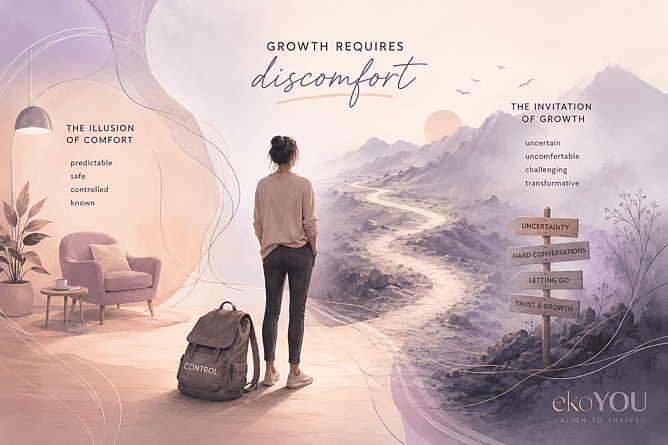
We live in a world engineered for comfort.
Climate-controlled homes.
Food available instantly.
Entertainment on demand.
Endless convenience.
Constant distraction.
And while comfort has improved many parts of life…
it may also be quietly weakening us.
Not physically.
Emotionally.
Because growth requires discomfort.
And modern life has made discomfort easier and easier to avoid.
I don’t enjoy discomfort.
I don’t enjoy uncertainty.
I don’t enjoy difficult conversations.
I don’t enjoy wondering how someone will react.
I don’t enjoy seeing people upset.
I don’t enjoy letting go of control.
But I’ve realised something important:
Avoiding discomfort does not remove it.
It usually amplifies it.
We understand this physically.
We stress the body to strengthen it.
We lift weights to build muscle.
We run to improve endurance.
We use saunas and ice baths to deliberately stress the system so it adapts and becomes more resilient.
Growth requires stress.
Yet emotionally and psychologically, many of us spend our lives trying to avoid discomfort entirely.
We seek certainty.
Control.
Predictability.
Safety.
Especially in business.
Especially in leadership.
Especially in family businesses.
For me, discomfort often comes from uncertainty.
What will happen?
How will they react?
Will they do the job as well as me?
What if they fail?
Am I still useful if I let go?
Am I still needed?
Am I becoming less important?
Those questions sit underneath far more business decisions than most people realise.
And often, we don’t consciously recognise them.
Instead, they show up as behaviours.
We do more ourselves.
We delay difficult conversations.
We avoid giving honest feedback.
We rescue people instead of letting them struggle and grow.
We hold onto decisions.
We stay indispensable.
We avoid succession.
We stay busy because action feels safer than uncertainty.
Not always because we are strong.
Sometimes because uncertainty feels uncomfortable.
Many founders and business owners believe they are protecting the business by staying in control.
But often, they are protecting themselves from discomfort.
That’s a very different thing.
Because control can create the illusion of safety.
If I stay involved in everything…
nothing will go wrong.
If I keep doing it myself…
the standard will stay high.
If I avoid the conversation…
the relationship stays intact.
If I rescue them…
they won’t struggle.
But eventually, these patterns become expensive.
Control becomes a bottleneck.
Rescuing creates dependency.
Avoidance creates resentment.
Silence creates distance.
Over-functioning creates exhaustion.
And the very thing we are trying to protect…
starts becoming weaker because of us.
This becomes especially visible in succession.
Succession is rarely just an operational problem.
It is often an emotional one.
Because succession requires founders to move through deep discomfort:
uncertainty
trust
identity shifts
loss of control
fear of becoming irrelevant
allowing others to lead differently
That is hard.
Especially for people whose identity has been built around being needed.
But businesses cannot truly scale while one person must remain central to everything.
Eventually, growth demands that others struggle, learn, adapt, and grow without us controlling every outcome.
And that requires discomfort tolerance.
The illusion is that comfort keeps us safe.
The insight is that too much comfort quietly limits growth.
Not all discomfort is good.
But avoiding every form of discomfort is dangerous.
Because the conversations we avoid today…
often become the crises we face tomorrow.
Maybe the goal is not to eliminate discomfort.
Maybe the goal is to expand our capacity to move through it consciously.
To stay grounded while uncertain.
To speak while uncomfortable.
To trust without controlling.
To allow others to grow.
To release the need to always be indispensable.
Because growth rarely feels comfortable while it’s happening.
And sometimes the next level of business, leadership, family, or life…
is waiting on the other side of a conversation, decision, or uncertainty we’ve been trying to avoid.
Final Reflection
Comfort preserves.
Discomfort transforms.
The question is:
What discomfort might your future be asking you to move through?
Suggestion
If this resonated, explore more in our “Illusion to Insight” series where we unpack the hidden patterns, beliefs, and behaviours quietly shaping businesses, relationships, leadership, and family dynamics.
Or explore the Abundance Scorecard to uncover where hidden friction may be limiting growth in your business and relationships.