Illusion to Insight: The Conversations We Avoid Are Often the Ones Controlling Our Lives
There’s a strange illusion many intelligent people live under:
“If I avoid the conversation long enough, things might improve on their own.”
But they rarely do.
Tension grows.
Distance grows.
Confusion grows.
Resentment grows.
And eventually, what could have been resolved in one honest conversation becomes a crisis.
In business, relationships, and family life, avoidance is rarely passive.
It is active protection.
Protection from discomfort.
Protection from conflict.
Protection from rejection.
Protection from disappointment.
Protection from uncertainty.
The problem is:
what protects us in the short term often damages us in the long term.
The Illusion
“Avoiding hard conversations keeps the peace.”
The Insight
Avoidance doesn’t create peace.
It creates silent misalignment.
Many people think conflict is the danger.
But often, the real danger is:
the conversation that never happened,
the expectation never clarified,
the resentment never expressed,
the boundary never set,
the truth never spoken.
Silence has a cost.
And in couples and families in business, that cost compounds.
The Insight
Avoidance doesn’t create peace.
It creates silent misalignment.
Many people think conflict is the danger.
But often, the real danger is:
the conversation that never happened,
the expectation never clarified,
the resentment never expressed,
the boundary never set,
the truth never spoken.
Silence has a cost.
Why We Avoid Crucial Conversations
People often explain avoidance logically:
“It’s not the right time.”
“I don’t want drama.”
“They won’t understand.”
“I need more information first.”
“I’m trying to protect the relationship.”
Sometimes those reasons are partly true.
But underneath the logic is usually emotion.
Fear of:
rejection,
conflict,
failure,
loss,
disconnection,
being misunderstood,
hurting someone,
being exposed,
losing control.
Neuroscientist Antonio Damasio helped demonstrate something profoundly important:
humans do not make decisions through logic alone.
Emotion is deeply involved in how we prioritise, assess risk, assign meaning, and choose action.
Which means many avoided conversations are not rational decisions.
They are emotional protection strategies.
Everyday Decisions Are Emotional Too
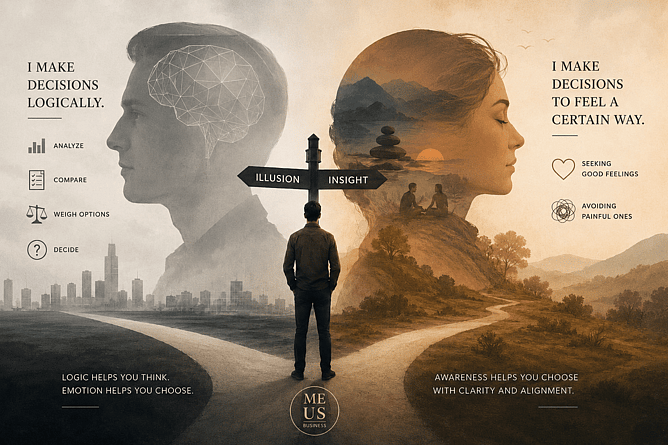
We like to believe we make decisions logically, but emotion quietly shapes far more than we realise.
Even simple choices are often tied to how we want to feel.
Take something as basic as choosing a pen. One person chooses an expensive executive pen because it makes them feel professional, capable, or successful. Another chooses a simple reliable pen because they value certainty, practicality, or calm. The decision feels logical, but emotion is still influencing what matters to them.
I was astounded to hear of the research where people with a disconnection between the logic and emotion parts of the brain could not choose a pen – even though they could logically explain their preference.
The same happens with cars, relationships, hiring, and business partnerships. We often think we are choosing based on logic alone, while unconsciously moving toward feelings like safety, validation, connection, certainty, freedom, or identity.
Logic matters.
But emotion often decides what matters first.
As neuroscientist Antonio Damasio discovered, emotion is not separate from decision-making — it is deeply woven into it.
The Hidden Cost of Avoidance
Avoidance rarely removes emotional tension.
It usually relocates it.
The unspoken issue leaks into:
sarcasm,
withdrawal,
overwork,
micromanagement,
passive aggression,
resentment,
indecision,
emotional shutdown,
fatigue,
loss of trust.
Eventually people say:
“We’ve drifted apart.”
But often they didn’t drift.
They slowly stopped telling the truth.
In Family Business, Avoidance Becomes Structural
In couples and families in business, avoidance becomes especially dangerous because silence affects both:
the relationship,
and the business.
A difficult conversation avoided at home becomes:
unclear roles,
poor accountability,
delayed decisions,
leadership confusion,
succession tension,
financial pressure,
emotional exhaustion.
Many businesses don’t suffer from a lack of strategy.
They suffer from accumulated unspoken truth.
The Irony
People often avoid crucial conversations to preserve connection.
But honest conversations — handled with care — are usually what create real connection.
Not superficial harmony.
Not walking on eggshells.
Not emotional suppression disguised as maturity.
Real connection requires truth.
Without truth, people may stay physically close while becoming emotionally distant.
The Real Goal Is Not More Conflict
This is important.
The goal is not to become aggressive, reactive, or brutally honest.
The goal is emotional courage.
To become conscious enough to ask:
What am I avoiding?
What emotion am I protecting myself from?
What truth needs language?
What tension keeps repeating because it has never been addressed?
What is the cost of continued silence?
Because every avoided conversation creates a hidden tax:
on energy,
on trust,
on clarity,
on intimacy,
on leadership,
and on growth.
The Insight
The conversations we avoid do not disappear.
They simply continue shaping our lives from the shadows.
Alignment is not the absence of difficult conversations.
Alignment is the willingness to have them before silence becomes disconnection.
Suggestion
If you feel tension building in your relationship, family, or business, it may not be a strategy issue.
It may be an unspoken truth issue.
The Alignment Code helps couples and families in business uncover the hidden misalignment beneath recurring tension, so they can move forward with clarity, connection, and confidence.