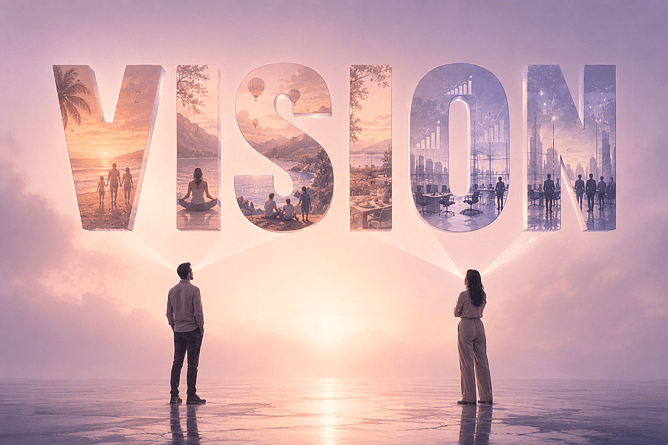
The Vision Illusion
“We’ve talked about our vision.”
It’s something we hear all the time.
And usually, people believe they have.
But when we ask what that vision actually is, something interesting often happens.
One person talks about freedom.
Another talks about growth.
One imagines family dinners and flexible schedules.
Another imagines expansion, impact, and building something extraordinary.
Both believe they’re describing the same future.
But they’re not.
And that’s where the Vision Illusion begins.
The Illusion
The illusion is believing that because we’re using the same words, we’re talking about the same thing.
Words like:
Vision
Success
Growth
Security
Freedom
Legacy
Balance
They sound obvious.
But often, they’re some of the most misunderstood words in relationships and business.
The challenge isn’t usually disagreement.
The challenge is interpretation.
Two people can sit in the same room, nod in agreement, and walk away with entirely different understandings.
Months later they wonder why they’re frustrated.
Years later they wonder how they drifted apart.
The Holiday That Never Happened
Here’s a conversation that I hear too frequently from people who have been in business a while ...
It varies in context but the underlying theme is the same.
One evening over dinner, “I thought once the business was successful, we’d finally have more freedom.”
Confused response. “What do you mean? We are successful.”
The business had grown.
Revenue was strong.
The team was capable.
From one perspective, we’ve achieved exactly what we set out to do ...
Building something meaningful that continued growing year after year.
But on the other hand one imagined …
Weekends away.
Long lunches with friends.
Being present for family milestones.
A business that created space.
Both had pursued “success.”
But neither had realised they meant different things.
It wasn’t a commitment problem.
It wasn’t a love problem.
It was a language problem.
The Hidden Problem
Many people use the word “vision” to describe entirely different things.
Sometimes they mean:
A Destination
Where we’re heading.
A Lifestyle
How we want life to feel.
A Purpose
Why we exist.
A Mission
What we do.
A Goal
What we’re trying to achieve.
A Strategy
How we’ll get there.
A Legacy
What we hope to leave behind.
An Identity
Who we want to become.
Each of these matters.
But they are not the same thing.
And when people confuse them, misalignment quietly grows.
“I Never Asked You To Take It Over”
A founder looking to exit had talked to his adult children.
For years he had said,
“The family values that have made this business successful must endure.”
One day, his son spoke to him,
“Dad, I’ve spent years feeling guilty because I don’t think I want to take over.”
The founder looked shocked.
“I never asked you to do that.”
What he had meant was:
“I want the values this business represents to continue.”
What his son had heard was:
“You are expected to become the next leader.”
The father’s words came from love.
The son’s understanding came from obligation.
Years of pressure had been built on an assumption.
One conversation changed everything.
Relief replaced guilt.
Curiosity replaced fear.
And they finally began talking about what legacy actually meant to each of them.
Why This Matters
Many business problems aren’t strategy problems.
They’re clarity problems.
And many clarity problems are actually language problems.
Consider this conversation.
One partner says,
“We need a bigger vision.”
What they mean is:
“I want us to create more freedom.”
The other hears:
“We need to work harder.”
Conflict follows.
Not because they disagree.
But because they interpreted the same words differently.
The Team That Couldn’t Decide
I remember one executive team that spent months revisiting the same decisions.
Every strategy meeting felt like déjà vu.
Finally, the CEO paused and asked,
“Before we continue, what does growth actually mean to each of us?”
Around the room came different answers.
“Expanding into new markets.”
“Improving profitability.”
“Reducing founder dependency.”
“Creating opportunities for our people.”
“Improving customer experience.”
Nobody had been wrong.
But nobody had been talking about the same thing.
The tension softened.
Not because everyone agreed.
Because everyone understood.
And from that point, progress accelerated.
The Insight
The most aligned people don’t assume they mean the same thing.
They become curious.
Instead of asking,
“What’s your vision?”
They ask,
“Vision of what?”
Ten Better Questions
Ten Better Questions
When someone talks about vision, ask:
Vision for your life?
Vision for your relationship?
Vision for your family?
Vision for your business?
Vision for your finances?
Vision for your wellbeing?
Vision for your impact?
Vision for the next year?
Vision for the next decade?
Vision for the legacy you hope to leave?
Notice what happens.
The conversation becomes clearer.
Deeper.
More human.
Perhaps You’ve Experienced This Too
The argument about money that was really about security.
The disagreement about growth that was really about freedom.
The tension around succession that was really about identity.
The repeated conversations that never seemed to go anywhere.
Maybe you weren’t on opposing teams at all.
Maybe you were simply using the same words to describe different hopes, fears and futures.
And maybe the conversation that changes everything isn’t:
“What do you think?”
But:
“When you say that… what does that mean to you?”
What We See at ekoYOU
One of the most common discoveries we see through The Alignment Code is that people are often more aligned than they realise.
The problem usually isn’t values.
It usually isn’t commitment.
It usually isn’t love.
The problem is that they’ve never unpacked the meaning behind the words they’re using.
Once they do, something remarkable happens.
Defensiveness drops.
Curiosity increases.
Understanding grows.
And alignment becomes possible.
A Simple Exercise
Take a piece of paper.
Write the word:
VISION
Then separately answer these questions:
What does vision mean to me?
What does success look like?
What do I want more of?
What do I want less of?
What would an abundant life look like?
What would I love our life to feel like in ten years?
Now compare your answers.
Don’t seek agreement.
Seek understanding.
You may discover you’ve been using the same words to describe very different futures.
Or you may discover you’re more aligned than you realised.
Either way, the conversation matters.
The Alignment Insight
Alignment doesn’t begin when people agree.
Alignment begins when people understand.
Because before we can get on the same page…
We first need to understand what page everyone is reading from.
Sometimes the greatest obstacle to alignment isn’t conflict.
It’s the illusion that we’re already talking about the same thing.
Reflection Question
What word do you use regularly in your relationship, family, or business that everyone assumes means the same thing?
Vision?
Success?
Growth?
Freedom?
Legacy?
Because hidden inside that word may be the very conversation that changes everything.
“Maybe you weren’t on opposing teams at all. Maybe you were simply using the same words to describe different hopes, fears and futures.”
About ekoYOU
At ekoYOU, we help couples, families and business partners create calm within themselves, harmony in their relationships, and profitability in their businesses.
Through The Alignment Code™, we help people uncover the hidden assumptions, conversations and misalignments that quietly create friction - and replace them with clarity, understanding and shared direction.
Because alignment isn’t soft.
It’s structural.