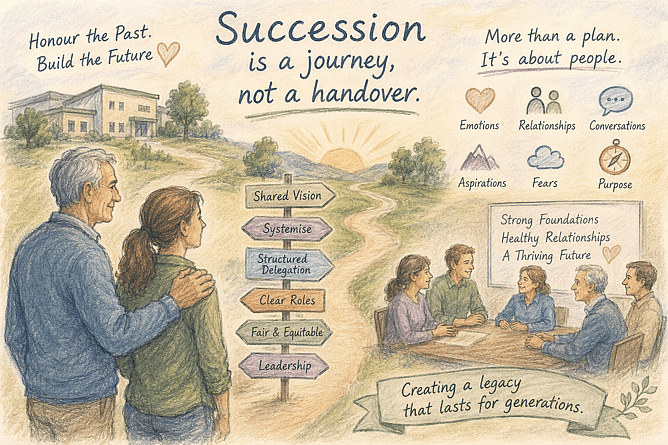
Succession Is Not a Handover. It’s a Human Journey.
For many founders, there comes a moment when the question changes.
It is no longer, “How do I grow this business?”
It becomes, “How do I ensure it thrives without me?”
For family businesses, that question carries even more weight.
Because succession is rarely just about transferring ownership.
It is about transferring responsibility, leadership, identity, relationships, trust and, in many cases, a lifetime’s work.
When sons or daughters have worked in the business for years, succession can appear straightforward from the outside. They know the customers. They understand the products. They have grown up around the business.
Yet this is often where some of the greatest challenges begin.
Because succession is not a technical exercise.
It is a deeply human journey.
The Myth of “They’ve Been Here for Years”
One of the biggest assumptions founders make is that because their children have worked in the business for a long time, they are automatically ready to lead it.
Time served does not equal leadership readiness.
Equally, children often assume that because they have invested years into the business, leadership should naturally follow.
Both perspectives contain some truth.
Neither tells the whole story.
Leadership is not inherited.
It is developed.
And stepping into leadership requires far more than knowing how the business operates.
It requires learning how to make difficult decisions, navigate uncertainty, build trust, lead people, carry responsibility and create a future that may look different from the past.
Founders Must Go Through Their Own Transition
Much of the conversation around succession focuses on preparing the next generation.
Far less attention is given to preparing the founder.
Yet founders often experience their own profound transition.
Many have spent decades building the business.
It has shaped their identity, relationships, routines and purpose.
Letting go is not simply about reducing hours.
It is about redefining who they are.
Questions begin to surface.
“Will they make the right decisions?”
“Will they undo what I built?”
“Will the staff still need me?”
“What will I do if I’m no longer running the business?”
These are not operational questions.
They are emotional ones.
Ignoring them doesn’t make them disappear.
It simply causes them to show up as micromanagement, delayed decisions, mixed messages or an inability to genuinely step aside.
The Next Generation Carries Different Questions
The children stepping into leadership are rarely free from uncertainty either.
Many feel enormous pressure.
They may wonder whether they have earned the opportunity or simply inherited it.
They worry about proving themselves to long-serving staff who still see Mum or Dad as the real decision-maker.
Some fear disappointing the founder.
Others fear never being fully trusted.
Many feel caught between respecting the past and creating the future.
Some don’t even know whether they truly want the responsibility.
These questions deserve space.
Succession should never assume willingness simply because someone is family.
Every Family Member Is on a Different Journey
One of the greatest mistakes businesses make is assuming everyone is experiencing succession in the same way.
They are not.
One sibling may be ready to lead.
Another may want ownership but not management.
Another may have no interest in either.
Parents may hold different expectations.
Spouses often have concerns that are never voiced.
Long-serving employees may quietly wonder where they fit.
Even customers can become anxious about what the future holds.
Succession involves an entire ecosystem of people.
Each carries different hopes, fears and expectations.
Understanding where each person is on their journey is not a “soft” exercise.
It is one of the most practical things a business can do.
Because people support what they understand.
They resist what feels unclear.
Start With a Shared Vision
Many succession conversations begin with ownership structures, tax advice or legal documentation.
Those things matter.
But they shouldn’t come first.
The first conversation should be about the future.
What kind of business are we trying to build together?
What values will remain unchanged?
What needs to evolve?
What does success look like ten years from now?
Without a shared vision, every operational decision becomes a negotiation.
With a shared vision, decisions have a common direction.
Vision becomes the anchor for every difficult conversation that follows.
Build a Business That Doesn’t Depend on One Person
One of the greatest gifts a founder can give the next generation is not ownership.
It is a business that can operate without constant founder intervention.
Many family businesses carry decades of knowledge inside one person’s head.
Important decisions rely on instinct.
Customer relationships rely on personal history.
Processes exist because “Dad knows how it works.”
That may have worked while the founder was actively involved.
It becomes a significant risk during succession.
Systemising the business is not about removing humanity.
It is about making wisdom accessible.
Documenting processes.
Clarifying decision rights.
Capturing experience.
Making expectations visible.
Reducing dependence on memory.
Every system created today reduces uncertainty tomorrow.
Delegation Is Not the Same as Letting Go
Many founders believe they are delegating.
In reality, they are supervising.
True delegation is structured.
It begins by clearly defining outcomes.
Then providing authority alongside responsibility.
Offering coaching without taking control.
Allowing mistakes while maintaining accountability.
Gradually increasing the complexity of decisions.
Leadership capability grows through experience.
Not observation.
Delegation is not one event.
It is a carefully designed progression.
Create Clear Roles Before Conflict Creates Them
Nothing creates tension faster than blurred responsibilities.
Who decides?
Who approves?
Who owns financial decisions?
Who manages staff?
Who handles strategy?
Who deals with customers?
Family relationships often make these questions harder because history quietly enters every discussion.
A structured organisation chart.
Clearly defined roles.
Decision authorities.
Leadership expectations.
Regular governance meetings.
These are not signs of bureaucracy.
They create fairness.
Everyone understands where responsibility begins and ends.
Family Should Never Replace Good Governance
Many founders avoid formal governance because “we’re family.”
Ironically, family businesses often need it most.
Good governance protects relationships.
It separates family conversations from business decisions.
It creates consistency.
It ensures difficult decisions follow agreed principles rather than personalities.
The healthier the governance, the healthier the family relationships often become.
Equity Means More Than Equal Shares
Few succession conversations become as emotionally charged as ownership.
Equal ownership does not always create fairness.
Nor does unequal ownership automatically create conflict.
The question is not simply, “Who gets what?”
It is, “What feels equitable based on contribution, responsibility, risk and future commitment?”
Some children may lead the business.
Others may not.
Some may work inside the business.
Others may pursue different careers.
Some may value income.
Others may value influence.
Fairness is not arithmetic.
It requires open conversations, transparency and shared understanding.
The earlier these discussions occur, the healthier they tend to be.
Leadership Must Be Developed Intentionally
Technical competence is only one part of leadership.
Future leaders need opportunities to develop communication, coaching, financial thinking, strategic planning, conflict resolution and decision-making.
They need mentors.
Feedback.
Stretch assignments.
Safe opportunities to fail.
Leadership should not begin on the day the founder retires.
It should be developed years beforehand.
The Journey Needs Structure
The strongest succession stories rarely happen by accident.
They follow a deliberate pathway.
One possible journey might include:
Understanding every person’s aspirations, concerns and readiness.
Creating a shared vision for the future.
Assessing leadership capability and development needs.
Clarifying roles, responsibilities and decision rights.
Systemising key business knowledge and processes.
Implementing structured delegation over time.
Building governance and accountability.
Reviewing ownership and equity arrangements.
Gradually transitioning leadership.
Supporting both founder and successor after the formal handover.
Each stage prepares people emotionally as well as operationally.
This Is About Legacy, Not Retirement
Perhaps the greatest misunderstanding about succession is believing it begins when the founder decides to retire.
It begins years earlier.
Every system documented.
Every responsibility delegated.
Every leadership conversation.
Every difficult family discussion.
Every decision to trust someone with greater responsibility.
These are all acts of succession.
The businesses that navigate this journey well don’t simply preserve what has been built.
They create something even more valuable.
Confidence.
Capability.
Healthy relationships.
Shared purpose.
A business that can continue creating value for another generation.
Because the true measure of succession is not whether ownership changes hands.
It is whether the people involved emerge stronger, more aligned and more capable of building the future together.
When succession is approached this way, it becomes far more than a legal process.
It becomes one of the greatest leadership journeys a family business will ever undertake.
Thinking about the future of your family business?
Whether you’re a founder preparing to step back or the next generation preparing to step up, succession is too important to leave to chance.
A structured succession journey helps families navigate the practical, emotional and leadership challenges that come with creating a business - and a legacy - that lasts for generations.
Let’s start the conversation before the handover becomes urgent.