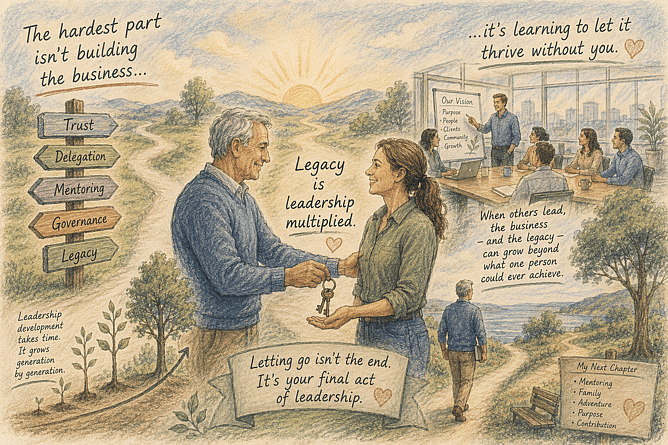
The Founder’s Hardest Job: Learning to Let Go
There comes a point in every founder’s journey when the biggest challenge is no longer building the business.
It’s releasing it.
For many founders, the business has been far more than a source of income.
It has been their purpose.
Their identity.
Their daily rhythm.
Their reputation.
In many cases, it has become part of who they are.
Which is why succession is rarely difficult because founders don’t trust the next generation.
It is difficult because letting go requires them to redefine themselves.
You Can’t Hand Over What You Still Need to Hold
Many succession plans stall for one simple reason.
The founder isn’t actually ready.
The paperwork may be progressing.
The ownership structure may be agreed.
The successor may be capable.
Yet every important decision still finds its way back to the founder.
Customers still call them first.
Staff still seek their approval.
Major purchases wait until they have the final say.
From the outside, it appears leadership has been delegated.
In reality, responsibility has.
Authority hasn’t.
The next generation can never fully step into leadership while the founder continues to occupy the space.
Letting Go Doesn’t Mean Walking Away
One of the greatest fears founders carry is that stepping back means becoming irrelevant.
It doesn’t.
There is an enormous difference between being involved and being indispensable.
The healthiest founders don’t disappear overnight.
They evolve.
Their role shifts from solving every problem to asking better questions.
From directing decisions to developing leaders.
From being the engine of the business to becoming its mentor and steward.
This isn’t less valuable.
In many ways, it’s the highest form of leadership.
The Invisible Fears Few Founders Talk About
Behind every succession conversation are questions that are rarely spoken aloud.
What if they make mistakes?
What if the business changes too much?
What if employees stop coming to me?
What if customers prefer the old way?
What if they don’t need me anymore?
And perhaps the hardest question of all:
Who am I if I’m no longer running this business?
These aren’t signs of weakness.
They’re signs that the business has mattered deeply.
Acknowledging these fears is not something to avoid.
It’s something to work through.
Trust Must Grow Before Control Can Shrink
Trust isn’t created on the day the founder retires.
It is built over years.
It grows every time responsibility is delegated.
Every time decisions are made independently.
Every time lessons are learned from mistakes.
Every time confidence replaces supervision.
Many founders wait until they feel completely comfortable before handing over authority.
Ironically, confidence usually comes after responsibility has been given - not before.
The Next Generation Needs Space to Lead Differently
One of the hardest realities for founders is accepting that their children won’t lead exactly as they did.
Nor should they.
The business they inherit is different.
The marketplace has changed.
Technology has changed.
Employees have changed.
Customers have changed.
Leadership must change too.
The goal of succession is not to create another founder.
It is to prepare the next leader.
That leader will bring different strengths.
Different ideas.
Different ways of building relationships.
Different ways of making decisions.
Difference is not disrespect.
It is evolution.
Legacy Is Built Through Development, Not Dependence
Some founders unintentionally create dependency.
Every difficult conversation comes back to them.
Every strategic decision requires their approval.
Every relationship revolves around their presence.
It feels responsible.
But over time it weakens the organisation.
The greatest legacy a founder can leave is not a business that still needs them.
It is one that no longer has to.
That is not failure.
It is evidence that leadership has been multiplied.
Letting Go Is a Process, Not an Event
Healthy succession rarely happens with a single announcement.
It happens through deliberate stages.
The founder gradually shifts operational decisions.
Then leadership responsibility.
Then strategic ownership.
Finally, they become available as a trusted adviser rather than the default decision-maker.
Each step builds confidence for everyone involved.
The founder.
The next generation.
The leadership team.
Customers.
Suppliers.
Even the family.
The transition feels natural because it has been practised.
What Comes After the Business?
Many founders spend years preparing the business for succession.
Far fewer prepare themselves.
What will give life meaning?
Where will purpose come from?
How will relationships change?
What contribution still wants to be made?
Some become mentors.
Some invest in new ventures.
Some focus on governance.
Some reconnect with family, travel or community.
The healthiest succession journeys don’t simply answer who will lead the business.
They also answer who the founder wants to become next.
The Greatest Gift a Founder Can Give
At first glance, succession looks like passing something on.
In reality, it is creating space.
Space for others to grow.
Space for new leadership to emerge.
Space for the business to evolve.
Space for the founder to begin a new chapter.
The businesses that flourish across generations are rarely those with the smartest legal structures or the most detailed succession plans.
They are the ones where founders understand that their final act of leadership is not holding on.
It is letting others stand where they once stood.
That is how businesses endure.
That is how families remain strong.
And that is how legacy is truly created.
Thinking about the future of your family business?
Whether you’re a founder preparing to step back or the next generation preparing to step up, succession is too important to leave to chance.
A structured succession journey helps families navigate the practical, emotional and leadership challenges that come with creating a business - and a legacy - that lasts for generations.
Let’s start the conversation before the handover becomes urgent.