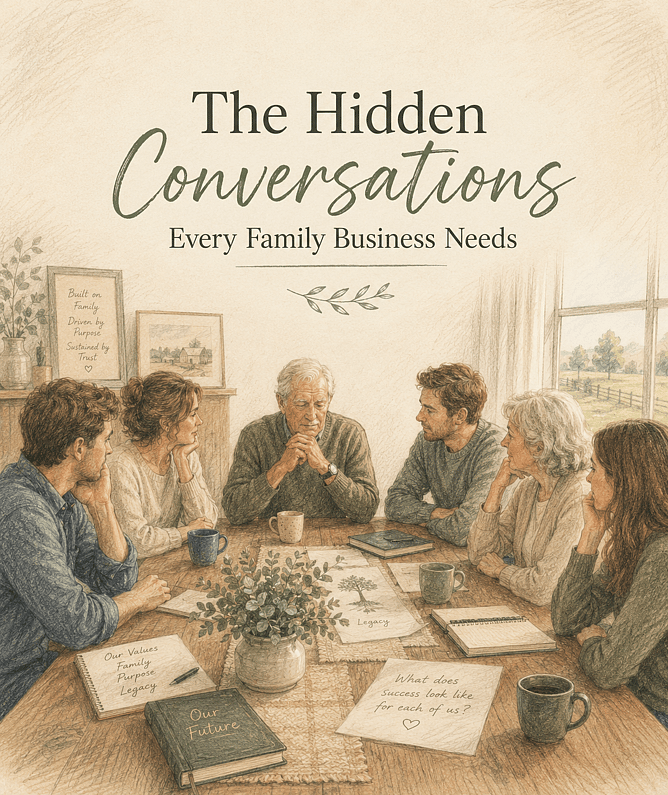
The Hidden Conversations Every Family Business Needs
There is a moment in almost every family business where everyone senses that something needs to be talked about.
No one starts the conversation.
Not because they don’t care.
Because they care too much.
The founder worries about upsetting the family.
The next generation worries about appearing entitled.
Siblings worry about damaging relationships.
Partners worry about saying the wrong thing.
So everyone waits.
Months become years.
Then one day, a crisis forces the conversation that should have happened long before.
Succession rarely fails because families don’t love one another.
It usually struggles because the most important conversations never happen.
The Silence Between the Meetings
Most family businesses have regular conversations about customers, cash flow, staffing and operations.
They discuss budgets.
They review performance.
They plan for the next quarter.
Yet the conversations that matter most often remain unspoken.
Questions such as:
What does the founder really want life to look like after stepping back?
Does the next generation genuinely want to lead, or do they simply feel obligated?
What if one child wants to own the business but not work in it?
How will decisions be made while two generations are leading together?
What happens if family relationships become strained?
What does “fair” actually mean?
These aren’t business questions.
They’re human questions.
And because they’re human, they’re often the hardest to ask.
Every Family Is Having Two Conversations
The visible conversation is about the business.
The hidden conversation is about identity.
For the founder, succession may feel like letting go of purpose, influence and a lifetime of work.
For the next generation, it may feel like trying to honour the past while creating a future of their own.
For siblings, it can raise fears of fairness, recognition and belonging.
For spouses, it often brings concerns that are never voiced around the board table.
Unless these hidden conversations are acknowledged, they quietly shape every visible decision.
The Cost of Avoidance
Avoiding difficult conversations can feel like keeping the peace.
In reality, it usually postpones conflict.
Small misunderstandings become assumptions.
Assumptions become stories.
Stories become resentment.
By the time succession is finally discussed, people are often responding to years of unspoken emotion rather than the issue itself.
The longer silence continues, the harder the conversation becomes.
Create Safe Conversations Before Critical Conversations
Healthy family businesses don’t wait until succession becomes urgent.
They create regular opportunities to talk while there is still time, flexibility and choice.
That means discussing topics like:
Individual aspirations.
Leadership readiness.
Decision-making responsibilities.
Ownership expectations.
Family values.
What success looks like for each generation.
What everyone fears but rarely says aloud.
These conversations aren’t about reaching immediate agreement.
They’re about building shared understanding.
When people feel heard, difficult decisions become much easier.
A Journey, Not a Single Conversation
One conversation won’t solve succession.
Neither will one family meeting.
The strongest transitions happen through a series of structured conversations over time.
Each conversation builds trust.
Clarifies expectations.
Strengthens relationships.
Creates confidence.
Succession isn’t simply transferring ownership.
It’s transferring understanding.
Reflection
Ask yourself:
What conversation has everyone in our family been avoiding because we believe it’s too difficult?
That conversation may be the very one that unlocks your future.
Thinking about the future of your family business?
Whether you’re a founder preparing to step back or the next generation preparing to step up, succession is too important to leave to chance.
A structured succession journey helps families navigate the practical, emotional and leadership challenges that come with creating a business—and a legacy—that lasts for generations.
Let’s start the conversation before the handover becomes urgent.